


English
Subject Information
Knowledge Organisers
Progression of Skills
Progression of Skills - English
Phonics
The Phonics Screening Check
The Phonics Screening Check
Children complete the Phonics Screening Check towards the end of Year 1 so parents can be confident that their children are learning to read successfully.
Children read 40 real and pseudo words – the check is carried out a familiar adult and usually takes between two and five minutes.
Traditionally 32 is the mark that indicates if a child has reached the standard of the check. Any children who do not meet this standard will continue to receive phonics teaching and support and will be re checked towards the end of Year 2.
The mark of 32 is subject to change by the Department of Education and schools are notified of any change in late June.
All children are supported to learn phonics using the Active Learn Phonics Bug Programme.
Phase 2 Phonics Actions
Phase 3 Phonics Actions
Phase 4 Phonics Actions
Learning at home
Reading
The importance and benefits of reading:
Research shows that reading helps to improve vocabulary, communication skills and also makes us better writers. We all need these skills in life and in our workplace. Consider talking to your child about when you use these skills in your own life and work. The increase in screen-time and social media has been shown to have decreased our focus and concentration levels as people are so used to flicking between apps and scrolling through various websites. Reading can help counter this by providing one thing to focus on. Did you know that reading has been proven to reduce stress? In today’s world, helping our children with this is so important.
Did you know that research shows children who read for pleasure achieve better, regardless of whether their reading material of choice is a novel or magazine? Please do encourage your child to read a variety of texts that they are interested in. Did you know research shows that a child who reads/is read to for 5 minutes a day will expose them to around 400,000 words a year? Increasing that to 21 minutes exposes them to 1,823,000 words a year. 40 minutes results in 3,646,000 words a year.
Suffolk Libraries
Why not join the library?
follow the link to join the library:
Joining the library (suffolklibraries.co.uk)
You can access thousands of free Libby App and Audio Books on Borrowbox:
Borrow & Download Books, eBooks, eMagazines - Suffolk Libraries
Magazines and newspapers are great to encourage reading and Suffolk Libraries offer a range of free titles about music, sports and more on the Press Reader app:
Borrow & Download Books, eBooks, eMagazines - Suffolk Libraries
Featherbed Tales
Featherbed tales lets you share beautiful stories brought to life with your own voice! Perfect for children developing their language skills and this is free from Suffolk Libraries:
Parenting - Advice, Resources & Support - Suffolk Libraries
Our Community Library
It has been wonderful to see so many families using our community library. With our philosophy of "Take a book, return a book", it means that the titles are ever changing. If the door is ever shut don’t be put off – open it and see what might grab you!

Book Suggestions
If you’re looking for book suggestions, you may like to explore bookheads.org.uk or schoolreadinglist.co.uk for booklists, or visit a site like www.barringtonstoke.co.uk which produces books for reluctant, less confident and dyslexic readers.
Have a look through the Non-Fiction November booklet - there are plenty of ideas to enjoy with friends and family!
Remember you can borrow non-fiction texts from our school library, the community library (by the school kitchen) or any Suffolk Library.
Rollama and SPaG.com
Speak to your class teacher if you have lost your login details:
- Rollama is a llama-themed universe of mini-games and teaching tools for spelling, punctuation, and grammar, with medals, leaderboards, avatars, competitions, and more!
- SPaG.com - for year 5 and 6 pupils - it offers grammar and punctuation tests for children to complete online
Phonics
Please practise the phonemes that pupils are taught at school.
Phonics improves the accuracy of the child's reading but not necessarily their comprehension. It is important that children are successful in making progress in all aspects of reading including comprehension and the development of vocabulary.
Please see videos that support correct pronunciation.
Handwriting - Kinetic Letters
Kinetic Letters is a handwriting programme for use in primary and secondary schools.
Four main threads of:
• Making bodies stronger,
• Holding the pencil,
• Learning the letters, and
• Flow and fluency
It enables children to develop legible handwriting that is produced quickly and automatically. With the development of automaticity, handwriting becomes a valuable tool and not a hindrance to learning.
The Kinetic Letters® font covers all the letters in the alphabet and is based on a set of rules that have been made as simple as possible to enable fast learning. The order in which letters are taught recognises the cognitive development of children. The programme can be used with any reading programme including phonics. Initially reading and writing are taught separately (as recommended by phonics programmes); later on, reading and writing are combined.
Strength: Writing is a fine finger operation; children must have core body and arm strength to be able to control their fingers precisely.
Pencil hold: The pencil/pen grip must be comfortable to allow writing for long periods (eg exams often last for hours). Pens and pencils with a triangular cross-section assist in developing the correct hold.
Letter formation: The movements to form the letters begin with whole body movements and progress through writing in sand trays to writing on whiteboards and finally writing on paper. In Kinetic Letters®, all the letters and numbers are formed by one of two monkeys, a brave one (Bounce) who goes to the top branch of the tree, and a scared one (Skip) who goes to the lower branch.
Flow and fluency: Letter movements are minimised to help a fast writing style to develop. There are no lead-in strokes (a waste of time and effort).
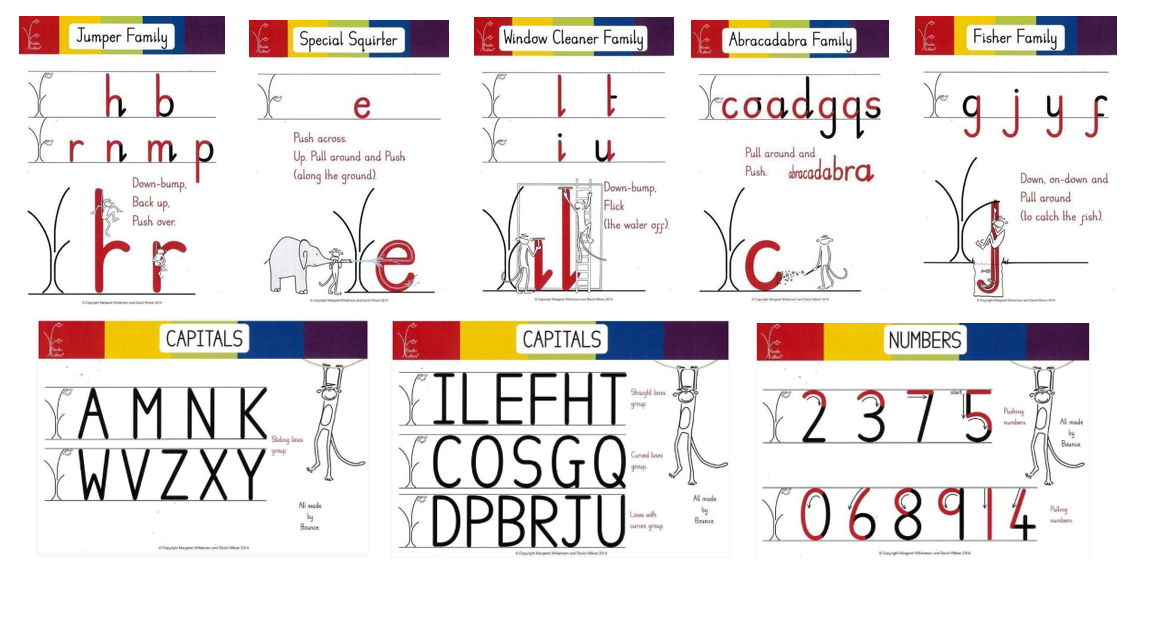
Kinetic Letter Formation Families
The Jumper Family Story
Bounce and Skip spend all day jumping down-bump from the branches of their tree!
Bounce jumps from the high branch and makes the letter trail for h and b.
Skip jumps from the low branch and makes the letter trail for r, n, m and p.
But...when Skip jumps down to make p, he gets a surprise! Instead of going bump, he falls on down into a pit that has a spider!
He jumps back up, pushing the cobwebs off to make the p letter trail!
The Abracadabra Family Story
Scared Monkey Skip finds a magician who waves his wand and shouts 'Abracadabra' and makes lots of different letters appear under the lower branch of the tree.
The magician teaches Scared Monkey the magic trick. He shows him that for each of the letters, he can pull around to write c, shout 'Abracadabra' and then magic it into o, a, d, g, q, or s.
The Scared Monkey makes all the letters start from his branch.
The Window Cleaner Family Story
The Monkeys find themselves in a city standing by a shop window! They watch two window cleaners making marks as they dry the windows. The pull the squeegees down the windows and flick the water off at the bottom!
The window cleaners let the Brave Monkey climb the ladder, pull the squeegee down the window, bump the ground and flick the water off! This makes a l and the t.
Scared Monkey is nervous about climbing the ladder so he stays on the ground and makes an i and u.
The Fisher Family Story
One day there is a huge storm in the jungle which makes the river flood the spider's pit. Bounce the Brave Monkey and Skip the Scared Monkey sit in their tree and watch the fish swim around in the pit. Skip discovers that if he sits on his branch and dangles his tail in the water, he can pull his tail around to catch the fish!
The Slider Family Story
One exciting day the magician waves his wand and takes Brave Monkey and Scared Monkey to see the snow!
Skip the Scared Monkey finds a snowy mountain slope and says 'I can slide down and slide up'. When he does this he can make the letters v, w, x and z.
Bounce the Brave Monkey goes to help the baby penguins who have lost their beaks! The penguins stand in line whilst the monkey fixes them back on and this makes the k!
The Special Squirter Story
A big storm has flooded the pit under the monkeys' tree. The mole rats are upset, as this is where they live.
First Skip rescues the fish that have been washed into the pit. Next he asks the elephant to help by sucking the water up in his trunk and squirting it back into the river.
Skip helps by holding the trunk and squirting it under his branch, leaving a letter trail of water behind in the air!
Kinetic Letters also helps us to write our capital letters and our numbers.
Book Reviews
KS2

